
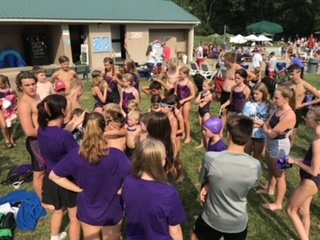


SWIM MEETS 101
All regular swim meets will begin at 6:30pm
Warm ups for home meets start at 5:30pm.
Warm ups for away meets start at 6pm.
- Swimmers should arrive at the pool 15 minutes before their warm up time, find where their team is sitting and put their towel, goggles & other belongings down.
- They should then locate the coaches, who will be writing swimmers’ events on their hands.
- Swimmers and parents should watch the hanging numbers, to know which events are lining up. (These numbers are typically on the fence behind where the lineup parents are and near the team area).
- The lineup parents will be in a designated area and have event cards for each relay team, or individual event swimmer.When a swimmer’s event is lining up, they go to the lineup parents, get their card (Parents: It's very helpful if you make sure your swimmer is aware when their event is lining up and actually walk them over to the lineup area) and then proceed to their lane. ONCE A SWIMMER IS AT THEIR LANE, THEY NEED TO STAY THERE UNTIL THEIR EVENT. Please don’t wander off.
- If a swimmer is not currently swimming, we ask that they remain in the team area or at the side of the pool, cheering for their teammates. (of course they are free to visit concessions or the restrooms when needed).
Swim Volunteer - Job Descriptions
*= detailed description of job at the bottom
Jobs Needed at Home AND Away Meets
| Job Name | Job Description | Volunteer Credits |
| Lane Parent | Helps organize swimmers (mainly the younger ones) at the far end of the pool, ensuring they are in the correct lane and heat for their event. | 1 |
| * Place Judge | Duties include judging the order of swimmers finishing the races. You sit on deck near the start/ finish end of the pool and monitor and record the order in which the swimmers finish. You are assigned to call which lane placed 1st, 2nd, or 3rd with 2 other parents from the team. | 1 |
| *Timers | The timer starts their stopwatch when the race starts and stops it when the swimmer in the lane in which they are timing touches the wall. The timer then records the time on the sheet provided. | 1 |
| *Score Keeper | Sit at the scoring table and keep score of the meet. | 1 |
| Swimmer Line Up | Organizes swimmers for their events, handing out cards that dictate heat and lane assignments, and verifies relay lineups. It helps to know the swimmers! | 1 |
Home Meet Only Jobs
| Job Name | Job Description | Volunteer Credits |
| Manual Set Up Coolers/Purchase Ice | Purchase ice and set up coolers (located at the pool) in preparation for concession beverages | 1 |
| Parking | Monitor the street traffic for safety purposes. | 1 |
| Concession Helper | Works in concession areas, stocking, selling, and serving drinks and food. | 1 |
| Grill Master | Grill food (typically burgers and hot dogs) during concessions | 1 |
| National Anthem Performer | Perform the national anthem by singing and/or playing it on a musical instrument at the start of the meet | 1 |
| 50/50 Raffle | Roam the pool grounds with a bucket and actively ask fans if they’d like to purchase 50/50 raffle tickets. Pull the winning ticket and announce the winner towards the end of the meet. Distribute the prize money and deposit the earnings in the safe. | 1 |
*Runner |
Be ready to walk, as you will get your steps in with this job. You will gather up timer sheets after each event and take them to the score table. | 1 |
| Clean up | After the Meet, clean up the concession area and put away coolers. Clean the area, straighten pool equipment, and put the steps back in the pool. | 1 |
Additional Jobs that Require Certification/Experience
If interested in taking on one of these jobs in the future, please contact a Brook Park Swim Team Committee Member and/or Head Coach.
| Job Name | Job Description | Volunteer Credits |
| Starter/Referee | Prior training and experience required. | 1 |
| Stroke and Turn Judge (certification required) | Prior training and experience required. | 1 |
| Announcer | Announce events and important messages during the Meet. | 1 |
End of Year (EOY) Swim Team Party Volunteers
| Job Name | Job Description | Volunteer Credits |
| Set Up/Bring Ice | Work with the EOY Swim Team Party Committee to set up prior to party. (A total of 3-5 bags of ice will be needed for party.) | 1 |
| Set up Team Picture/Gift Table | Set up team pictures and gifts for swimmers to pick up at the EOY party. | 1 |
| Serve food | Help serve food at the EOY party. | 1 |
| Serve dessert/Clean up | Help serve dessert and clean up after the party. | 1 |
3 Credit Volunteer Jobs
| Job Name | Job Description | Volunteer Credits |
| Team Party Committee Member (2-3 Committee Members Needed) |
As an End-of-Year Swim Team Party Committee member, you will work together with the EOY Party committee members to plan dinner and dessert for the EOY party. | 3 |
| Concession Leads | For home meets only, 1-2 individuals will oversee the concession stand. This includes setting up (with volunteers), staying with the concessions, counting the money (depositing it in the safe that night), and cleaning up the event (with volunteers). There are coolers, a grill, storage space, and some refrigeration at the pool. Cash box with change provided. |
3 |
*Detailed Job Descriptions
1. Scorer:
(Home and Away Meets)
Scorers usually sit at their own table, one scorer from the home team, and one scorer from the away team. They are provided with four sets of meet sheets, two sets from each team. Before the meet begins, the scorers sit down and cut the other teams’ meet sheets and paste the opposing team’s swimmers names onto the lineup. The other team’s scorer does the same, so you both end up with one complete set of meet sheets, containing the list of all the events and all the swimmers’ names.
After each event, the runner deposits all of the swimmers’ cards at the scorer’s table. The scorers take turns viewing the cards, writing down the information from first, second, and third place cards, and their times, and then recording the team points. Then, the team points are cumulatively added in its own column. The other scorer does the same, and in this way, you are able to check each other’s addition.
Meet Scoring
Individual Events:
| 5 points for first place |
| 3 points for second place |
| 1 point for third place |
Relays:
| 6 points for first place |
| 3 points for second place |
| 1 point for third place |
When the meet is finished, each scorer keeps the cards from their team, in order, if possible. The cards are secured with a rubber band. At the end of the meet, the meet sheets are wrapped around the cards within the rubber band, and all of the meet information is secured together to pass on to the coaches.
Sometimes, scoring gets confusing when there are many heats of the same event. But the scorer should remember that the first heat of an event is the only one that counts, even if later heats are faster. In this case, the alternate cards are just added to the other swimmers’ cards.
Scoring may also be confusing when swimmers are switched at the last minute, and swimmers’ cards do not match your meet sheets. Do your best to verify your information by asking a coach or the swimmer if you are unsure.
Scorers are not expected to broadcast the score throughout the meet, in fact, they are expected to be discreet, in order to discourage swimmers from requesting the score throughout the meet. Periodically, the starter will announce the standings of the score.
Scorers are able to leave the scorer’s table in order to see their swimmer’s events. Often, scorers have the best seat in the house!
2. Timers:
(Home and Away Meets)
- Are provided with stopwatches, clipboards, and event lists.
- Should identify the backup timer, and know how to call for a back up time if they make a mistake.
- Are assigned to a lane, hold a clipboard with a list of meet events and pen, and have a stopwatch around their necks.
- As swimmers come up to the lane, they give the timer a card that has the swimmer’s name, team, and a space for their time.
- Timers watch the starter. When the starter gun or whistle goes off, then they push the button.
- Timers pay attention to the amount of lengths the swimmer(s) swim. It could be one, two, four, or eight. 25 = one length; 50 = two lengths; 100 = four lengths; 200 = eight lengths
As the swimmer comes down to the finish, the timer leans over the edge, and watches for the exact moment that the swimmer touches the wall, and presses the button. It does not matter if the swimmer touches the wall with his hand, head, or other body part. The timer pushes the button at the exact moment that any part of the swimmer touches the wall.
The timer notes the time, and writes it down on the swimmer’s card.
The timer looks up to the place judges. If the swimmer has placed first, second, or third, then the place judges should let the timer know, and the timer writes the place down on the card, and circles it. If there is no place, then do nothing.
If a swimmer is an alternate, then the time is noted on the card, but the place is not.
If a swimmer is disqualified, the stroke judge should let the timer know. The swimmer’s time is still recorded, and the card is marked with a DQ and circled. If possible, the stroke judge should let the timer know the reason, and it should be recorded on the card, as well.
The timer then gives the card to the runner, clears the stopwatch and goes on to the next event.
The starter always stays at one end of the pool. Timers move to the different ends of the pool depending on whether the event is one lap or two or more. The starter will tell the timers and judges when to move to other ends of the pool.
3. Place Judge:
(Home and Away Meets)
Three parents are required from each team. These volunteers decide the first, second and third place finishes after each event is run. This is how it works:
1) Before the meet begins, the three judges decide who will do first, second, and third place.
2) When called for the “Officials Meeting” before the meet begins, the home team will then introduce themselves to the opposing team’s judges, and learn who is doing the same place. There will be two people (one from each team) to determine 1st, 2nd, and 3rd place.
3) The home team judges go to the finish end of the pool on one side. The opposing team’s judges go to the finish end of the pool, on the other side.
4) The event is run, and the place judge must note which swimmer/lane finished in his/her assigned place. For example, if you are doing first place, you must note which lane has the swimmer who finished first.
5) You hold up the same amount of fingers of the lane of the swimmer that finished in your assigned place, and look to the other’s team judge to agree. For example, if you are doing first place, you see that the swimmer in lane three finished first, and you hold up three fingers, and look to the other team’s first place judge to hold up three fingers.
6) Once the place judges agree, they tell the timers of those first, second, and third place lanes, so that the timers can note it on the swimmers’ cards. For example, the first place swimmer finished in lane three, the first place judge tells the timer in lane three: “Your swimmer finished first”.
7) If place judges don’t agree, they must confer, look at times, and consult with the meet referee.
8) If there is a disqualification, the scorers will look at the times and figure out the places.
4. Runner:
(Home Meets only)
The runner is an important part of making a swim meet run smoothly.
Each swimmer, or relay team is given a card before their event that lists all the swimmers’ names, and leaves a space for the swimmer’s time and place after the event is done. When a swimmer is ready to swim, they give this card to the timer.
After the event is done, runners wait until the timers have a chance to record the times on their cards, and then collect all the cards from all the lanes, and takes them to the scorer’s tables.
If a runner is really good, he/she will sort the cards before giving them to the scorers. (i.e.: so that the cards that list first, second and third place are on top of the pile.)
The only confusing part of this position is during the 25 yd. events. In these events, the swimmers are at one end of the pool, and the timers are at the other end of the pool. In addition, these events run quickly, there are many heats of the same event, and they involve the littlest swimmers who are often confused. Many of these swimmers are swimming as “alternates” which means that they are not swimming to count as points for the team, (it gives experience and an official time for the swimmer). In these cases, alternate heats don’t count, and there are no places given. Only the first heat counts for places and team points.
The runner must take the cards from all the swimmers, one event at a time, and take the cards to the correct lane/timer on the other side of the pool (again, this is for 25 yd events only). After the event is run, the cards must be collected from the timers and taken to the scorers’ table. Before the next event or heat is run, the swimmers’ cards must be collected from the next swimmers and taken to the other side of the pool to the timers. As you can tell, it is a good idea to have two runners during this time. (Events 9-12).